Video SEO Singapore: How to Rank Video Content Now
- November 16, 2026
- Business Insights
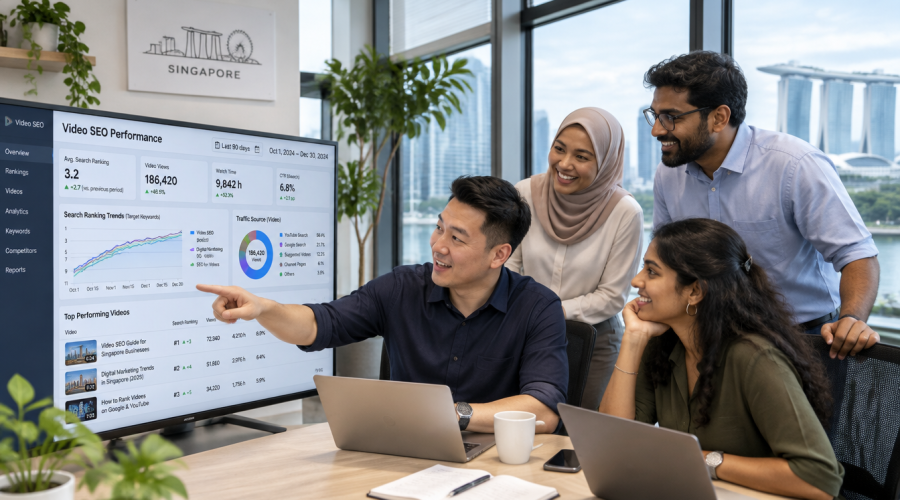
Type a how-to question into Google today and there is a fair chance a video thumbnail appears before a single blue link does. That shift did not happen quietly. Over the past year, Google’s AI Overviews have leaned hard on video as a source, and YouTube has become the single most-cited domain in AI-generated answers, well ahead of any text-based publisher.
For many Singapore businesses, video SEO Singapore strategy still gets treated as a social media afterthought: a few Reels for brand awareness, perhaps a product demo buried near the bottom of a service page. Treating video as a genuine search channel, with its own technical requirements and its own way of being measured, is becoming hard to ignore.
Why Video Has Become a Ranking Signal, Not Just a Content Format
According to data from BrightEdge, reported by Search Engine Land, up to 29.5% of Google’s AI Overviews now cite YouTube as a source, giving the platform roughly a 200-times advantage over its nearest video competitor. Perplexity and ChatGPT show a similar pattern, pulling from YouTube even when there is no obvious commercial reason for either tool to prefer it over a text page.
The reason is mostly structural. A well-produced video arrives with a transcript, timestamps, a title, a description and often chapter markers already built in, which gives an AI system a tidy, pre-segmented answer it can lift almost directly. Tutorials, pricing explainers, product demonstrations and reviews show up disproportionately often among cited videos, which maps neatly onto the kind of research-heavy questions Singapore buyers tend to ask before they commit to a purchase or a service provider.
Where Singapore Audiences Are Actually Watching
The audience is already there. Singaporeans now spend more than 10 hours a week watching online video, according to the Digital 2026: Singapore report from We Are Social and Meltwater. TikTok wins on daily engagement, with users spending an average of 1 hour and 39 minutes on the app each day, while YouTube sessions run longest at just over 13 minutes each, a sign that viewers settle in instead of scrolling past. A workable video SEO plan usually prioritises a handful of channels instead of spreading production effort thin across every platform at once:
- YouTube: still the default home for longer explainer and tutorial content, and the platform Google’s own AI systems cite most heavily.
- TikTok: best suited to short, fast-paced clips that build awareness, not to answering detailed research questions.
- Instagram Reels: useful for repurposing TikTok-style clips to reach an audience that overlaps but is not identical.
- Google’s own video surfaces, including the video carousel, Discover feed and AI Overviews, which reward video regardless of which platform hosts it, provided the technical basics are in place.
Getting the Technical Foundations Right
The first decision is where a video actually lives. Hosting on YouTube and embedding it gives a business the platform’s own search and recommendation engine for free, at the cost of sending some of that traffic and watch time to YouTube instead of the business’s own site. Self-hosting keeps visitors on-site for longer but means handling indexing, a video sitemap and page speed without YouTube’s infrastructure doing the heavy lifting.
Either way, adding VideoObject structured data markup tells search engines what a video is about before they have watched a single frame of it: its duration, upload date, thumbnail and a short description. This works the same way broader structured data markup does across a site, and any business that has not reviewed its wider schema setup recently should treat that as the starting point before layering video markup on top.
Transcripts and captions go beyond accessibility. They give crawlers and AI systems searchable text to work from, and they are often the single easiest lever for getting a video cited inside an AI-generated answer, not just surfaced in a results carousel. A video with no captions is, to most crawlers, little more than a thumbnail and a file size.
On-Page Details That Help Video Get Found
Once the technical groundwork is in place, a short list of on-page details decides whether a given video actually surfaces for the right query.
- A descriptive, keyword-relevant filename instead of a default camera export name.
- A title that leads with the main keyword in the first few words, written for a person and not stuffed for an algorithm.
- A full description with a natural summary up top and a timestamped breakdown of what the video covers further down.
- A custom thumbnail that accurately represents the content, since misleading thumbnails tend to hurt watch time and, in turn, ranking.
- Chapter markers for anything longer than two or three minutes, which double as the segmentation an AI system looks for.
- An uploaded captions file instead of relying solely on auto-generated captions, which still make frequent errors with local names and Singlish terms.
Tracking Whether the Effort Is Paying Off
Google Analytics 4’s video engagement events, YouTube’s own analytics dashboard and Google Search Console’s video indexing report together cover most of what a business needs: which videos are being watched, for how long, and whether Google has actually indexed them as video content and not just treated the page as plain text.
Measuring citation inside AI Overviews directly is harder, since none of the major platforms publish a reliable per-video citation report. The practical workaround is to monitor branded search volume and direct traffic alongside video performance, since a genuine lift in both over a few months is a reasonable proxy for AI visibility even without a dashboard that says so outright.
Video is not a replacement for the rest of an SEO programme, and it will not fix a site with weak technical foundations underneath it. Built properly, though, it is one of the more direct ways a Singapore business can show up inside the answers AI tools are already giving. If your team wants a hand working video into a wider content and technical SEO plan, feel free to reach out to us.





More from our blog
See all posts