Website Accessibility and SEO for Singapore Businesses
- October 12, 2026
- Business Insights
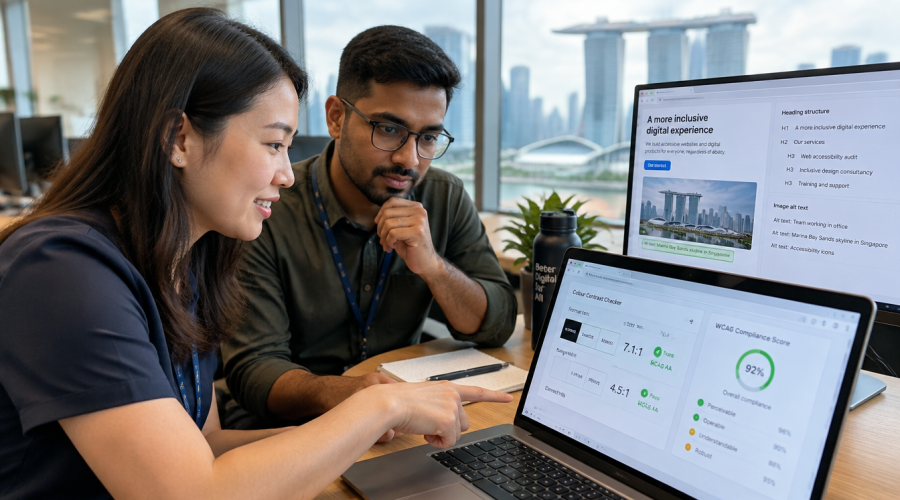
A visually impaired shopper lands on a Singapore e-commerce site, opens a product page with a screen reader, and hits a wall of unlabelled images and low-contrast text. She leaves within seconds. So does the next visitor who hits the same wall, screen reader or not, because the page simply asks too much of anyone trying to read it quickly on a train or a small screen.
That scenario sits at the centre of a question more Singapore businesses are starting to ask: does website accessibility actually affect SEO, or is it a separate compliance exercise altogether? The honest answer is both, and the overlap between the two is wider than most site owners assume.
What Website Accessibility Actually Means
Website accessibility is the practice of building pages that people with visual, auditory, motor or cognitive differences can still use, generally measured against the Web Content Accessibility Guidelines (WCAG). In practice this covers things like alt text on meaningful images, captions on video, a logical heading structure, sufficient colour contrast, and a site that works with a keyboard alone, not just a mouse or touchscreen.
Why Google Still Won’t Call It a Ranking Factor
Google has been consistent on one point: accessibility is not a direct ranking signal. As Search Engine Journal’s coverage of the remarks lays out, Google’s Search Advocate John Mueller said as much during a Search Central office-hours session, noting that the company has no reliable way to measure accessibility objectively across the web the way it measures load speed or mobile-friendliness. He did, however, point to Core Web Vitals as an example of how a subjective quality like page experience eventually became a quantifiable one, and left the door open to something similar happening for accessibility over time.
That nuance carries more weight than the headline. A page that is hard to navigate loses visitors fast, and those visitors rarely come back or share the page with anyone else. Search engines pick up on exactly that kind of behaviour through engagement signals, even without an “accessibility score” sitting anywhere in the ranking algorithm.
Where Accessibility and SEO Genuinely Overlap
Most accessibility fixes happen to be SEO fundamentals wearing a different name. Descriptive alt text that helps a screen reader also feeds Google’s image search. A clean heading hierarchy that lets assistive technology jump between sections is the same structure that helps both users and crawlers understand what a page is actually about. Fast, well-contrasted, easy-to-scan pages tend to post a stronger Core Web Vitals score, which genuinely does factor into Google’s page experience signals.
The clearest overlaps worth fixing first are usually:
- Alt attributes on every image that carries meaning, not just a filename left blank
- Descriptive link text instead of vague phrases like “click here” or “read more”
- A single H1 per page with H2 and H3 tags used in proper hierarchical order
- Colour contrast and font sizing that stays readable on a small, bright-sunlight mobile screen
Singapore’s Own Push Toward Digital Inclusion
The push toward inclusive digital services is not just a Western regulatory trend. Singapore’s own Digital Service Standards, maintained by GovTech, already draw on WCAG and are being expanded to give public agencies clearer guidance on building services usable by people of all ages and abilities. The direction is primarily aimed at government platforms for now, but it signals where expectations are heading more broadly.
Private businesses are not yet bound by the same requirements, and this article makes no claim about any specific legal obligation applying to commercial websites in Singapore. The relevant point is simply that an ageing population and a growing base of users with disabilities make digital inclusion a real commercial consideration, not an edge case.
Businesses that serve customers overseas should also keep in mind that some markets, the United States in particular, have seen a sharp rise in legal claims over company websites being unusable for people with disabilities. That is a separate risk conversation from SEO, but it is one more reason the groundwork pays off when it is laid early instead of retrofitted later.
A Practical Starting Checklist for Singapore Websites
None of this requires every page being rebuilt at once. Most sites can make meaningful progress with a short, focused pass through their highest-traffic pages first.
A sensible starting list for this quarter looks like:
- Run a free automated scan (tools like WAVE or Google’s own Lighthouse audit are a good start)
- Add alt text to product images, hero banners and infographics that carry real information
- Check contrast ratios on buttons and calls to action, not just body text
- Confirm the site can be fully navigated using the keyboard’s Tab key alone
- Add captions or a transcript to any video content used in marketing pages
- Test two or three key pages with a free screen reader such as NVDA to see what a real user experiences
What This Means for AI Search Too
The same structural discipline that helps assistive technology also helps the AI systems now summarising and citing web content directly. Clean semantic markup, properly nested headings and descriptive text give both a screen reader and an AI crawler the same thing: an unambiguous map of what a page says and how its parts relate to each other.
As more search behaviour shifts toward AI-generated answers rather than a list of blue links, that shared technical foundation stops being a nice-to-have. Businesses already investing in clear, well-structured content for human readers are, often without realising it, also building the exact groundwork that helps them get picked up and quoted correctly by AI search tools.
Getting all of this right across an entire site can feel like a lot to take on alongside everything else on a marketing calendar. If it would help to have a second pair of eyes on where your own site stands, our team would be glad to get in touch and walk through it with you.



More from our blog
See all posts