International SEO for Singapore Businesses Going Global
- October 2, 2026
- Business Insights
A great product rarely struggles to sell within Singapore’s shores. The moment a business looks outward, to Jakarta, Ho Chi Minh City or Sydney, the website that converts perfectly at home can quietly sabotage every other effort behind an overseas launch.
That is not a problem reserved for a handful of multinationals. Eight in ten Singapore SMEs now say overseas expansion is a priority for 2026, with reaching new customer bases and building a stronger overseas brand presence cited as the top two reasons, according to a DBS survey of 730 local companies. International SEO, the practice of structuring a website so it can be found and trusted in the languages and regions of each new market, is the unglamorous groundwork that decides whether that expansion is ever seen by the people it is meant for.
Why a Local SEO Playbook Does Not Travel Well
Ranking well in Singapore’s Google results says very little about how a site will perform once the audience and device habits change at the border. A page built to answer “air conditioning servicing Singapore” will not automatically answer the same question for a reader in Kuala Lumpur, where currency, delivery expectations and even public holidays differ. Expanding overseas without adjusting the underlying approach usually means duplicating a Singapore-first site elsewhere and hoping the algorithm works out the rest, which is the core reason international SEO needs its own playbook rather than a copy of what already works at home.
Choosing a Site Structure Before You Choose a Market
The decision of how to house international content comes before almost everything else, because changing it later usually means rebuilding a market’s authority from zero. A subdirectory structure, such as a /my/ or /id/ folder on the main domain, shares existing domain authority across every market and is the most practical choice for a business testing one or two new countries without a dedicated regional budget.
A subdomain, such as my.company.com, suits a business that wants some independence for a regional team without the cost of a separate domain, though it inherits slightly weaker authority than a subdirectory does. A country-code domain such as company.com.my sends the strongest signal of local commitment, but it starts from zero authority and usually only pays off once a market has earned sustained investment. Most Singapore businesses expanding regionally for the first time are better served starting with subdirectories and revisiting the question once a market proves itself.
Getting Hreflang Right the First Time
Hreflang tags tell search engines which version of a page to show a reader based on language and location, and they are also where most expansions quietly go wrong. An international SEO guide from Search Engine Land points to four mistakes that repeatedly undo otherwise solid campaigns:
- Missing reciprocal tags, where a Singapore page points to its Malaysian equivalent but the Malaysian page does not point back, which can cause search engines to disregard the entire setup
- Outdated language codes, such as writing “en-uk” instead of the correct “en-gb,” which quietly invalidates the tag
- No self-referencing tag, meaning a page fails to list itself among its own language and region alternates
- Hreflang tags pointing to broken, removed or redirected URLs, which confuses search engines instead of clarifying which version should rank
None of this is visible to a reader browsing the site normally, which is exactly why it so often goes unnoticed until traffic from a new market fails to materialise months into a campaign.
Writing for the Market, Not Just Translating the Page
Running a Singapore page through machine translation and publishing it under a new URL is tempting, and it is also one of the fastest ways to undermine credibility in a new market. The same Search Engine Land research notes that 76% of consumers prefer to read product information in their own language, but the preference is for well-written local content, not a literal translation that misses idiom, currency formatting or local search habits.
Genuine localisation means adjusting examples, case studies and even the keywords themselves, since the phrase a Singaporean searches for a service is rarely the phrase a Jakarta or Manila resident would type. Price points, measurement units and local regulatory references all deserve the same attention as the headline copy, because search engines and readers both notice when a page feels like an afterthought instead of a market-specific resource.
The Technical Groundwork Most Businesses Skip
Beyond content, a handful of technical settings quietly decide how international pages get crawled and ranked. Setting geotargeting in Google Search Console for each subdirectory or subdomain tells Google which country a section is meant to serve, which matters most for generic top-level domains that carry no country signal of their own. Page speed deserves a second look too, since a server or CDN tuned for Singapore can add noticeable latency for a reader elsewhere in the region, and canonical tags need checking so near-duplicate pages across markets are not accidentally competing for the same ranking. Getting this architecture right from the outset is far easier than untangling it after launch, which is why many businesses bring in specialists in cross-border SEO before their first overseas page goes live.
Earning Local Trust, Market by Market
Domain authority built in Singapore carries some weight everywhere, but it rarely transfers in full to a brand-new market, where local trust signals still do much of the heavy lifting. Building credibility in each new region usually involves:
- Securing listings in that country’s leading business directories, not just Singapore-based ones
- Earning coverage or mentions from local publications and industry sites readers already trust
- Collecting reviews from customers in the new market, in the local language where possible
- Partnering with in-market distributors, resellers or affiliates who can link back to the new site
- Adapting social proof, such as testimonials and case studies, to reference recognisable local names and results
Measuring Whether It Is Actually Working
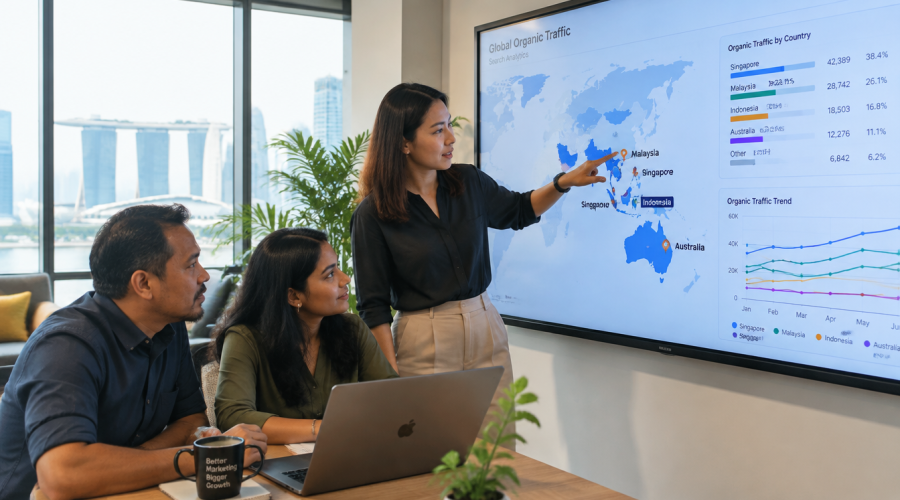
Success or failure plays out market by market, so a single blended traffic number hides more than it reveals. Segmenting Google Analytics 4 by country and language shows whether a specific market is gaining organic visibility at all, instead of assuming growth in one region quietly offsets stagnation in another.
Worth tracking alongside raw traffic: organic rankings for the same core terms in each target market, the conversion rate broken down by region, and how quickly a new market’s organic traffic climbs relative to how long it has been live. A market that is six months in and still flat deserves a structural review, not simply more content.
Bringing It Together
Expanding overseas is, in the end, still a Singapore story: a local business backing itself to compete somewhere new. Getting the search foundations right from day one gives that confidence a better chance of being seen. If your team is weighing a first overseas market, or untangling a site that already serves several, get in touch with IT.com.sg and we can walk through what the data is telling you.





More from our blog
See all posts